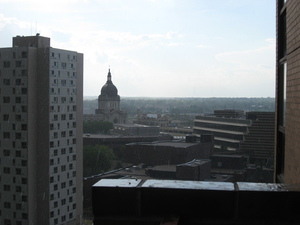
- Basilica of St. Mary, Minneapolis (MNopedia)
During his Christmas Day sermon in 1903, Archbishop John Ireland announced that Minneapolis was to become home to a large and impressive new Catholic church that would share the seat of the archdiocese with the Cathedral of St. Paul. The church, named the Church of the Immaculate Conception, was popularly known as the Pro-Cathedral of Minneapolis. It cost one million dollars to build and held its first Mass in 1914. In 1926, the Catholic Church designated the pro-cathedral the Basilica of Saint Mary, making it the first basilica in the United States.
- Karl Marx (Wikipedia)
Karl Marx (German: [maʁks]; 5 May 1818 – 14 March 1883) was a German-born philosopher, political theorist, economist, historian, sociologist, journalist, and revolutionary socialist. His best-known works are the 1848 pamphlet The Communist Manifesto (with Friedrich Engels) and his three-volume Das Kapital (1867–1894); the latter employs his critical approach of historical materialism in an analysis of capitalism, in the culmination of his intellectual endeavours. Marx’s ideas and their subsequent development, collectively known as Marxism, have had enormous influence on modern intellectual, economic and political history.
- Basilica of Saint Mary (Minneapolis) (Wikipedia)
The Basilica of Saint Mary is a Catholic minor basilica and co-cathedral located on Hennepin Avenue between 16th and 17th Streets in downtown Minneapolis, Minnesota, in the United States. Dedicated in 1913, Saint Mary became the first American basilica when Pope Pius XI raised it to the status in 1926. The Basilica of Saint Mary is the co-cathedral for the Archdiocese of Saint Paul and Minneapolis.