- Inside the Apple-1’s unusual MOS clock driver chip (righto.com)
Apple’s first product was the Apple-1 computer, introduced in 1976. This early microcomputer used an unusual type of storage for its display: shift register memory. Instead of storing data in RAM (random-access memory), it was stored in a 1024-position shift register. You put a bit into the shift register and 1024 clock cycles later, the bit pops out the other end. Since a shift-register memory didn’t require addressing circuitry, it could be manufactured more cheaply than a random-access memory chip.1 The downside, of course, is that you had to use bits as they became available, rather than access arbitrary memory locations. The behavior of shift-register memory was a good match for video circuitry, though, since characters are displayed on the screen in a fixed, repeating order (left to right and top to bottom).
- Cathedral (Wikipedia)
A cathedral is a church that contains the cathedra (Latin for ‘seat’) of a bishop, thus serving as the central church of a diocese, conference, or episcopate. Churches with the function of “cathedral” are usually specific to those Christian denominations with an episcopal hierarchy, such as the Catholic, Eastern Orthodox, Anglican, and some Lutheran churches. Church buildings embodying the functions of a cathedral first appeared in Italy, Gaul, Spain, and North Africa in the 4th century, but cathedrals did not become universal within the Western Catholic Church until the 12th century, by which time they had developed architectural forms, institutional structures, and legal identities distinct from parish churches, monastic churches, and episcopal residences. The cathedral is more important in the hierarchy than the church because it is from the cathedral that the bishop governs the area under his or her administrative authority
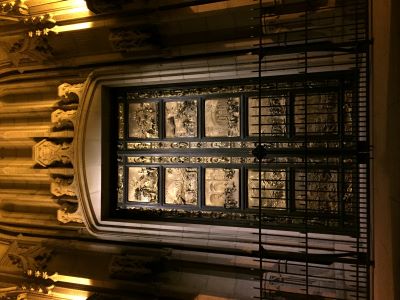 Ghiberti doors at Grace Cathedrial