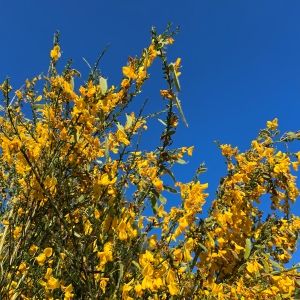
- Cytisus scoparius has been introduced into several other countries and continents, outside of its native range, and is commonly classified as a noxious invasive species in western North America, mainly in British Columbia (including on Vancouver Island), California, Oregon, Washington (west of the Cascades), the Sierra Nevada range, fragmented areas of North America’s eastern seaboard, as well as Australia (where it is a declared weed), New Zealand, and in India.
- Cytisus scoparius (Wikipedia)
Cytisus scoparius (syn. Sarothamnus scoparius), the common broom or Scotch broom, is a deciduous leguminous shrub native to western and central Europe. In Britain and Ireland, the standard name is broom; this name is also used for other members of the Genisteae tribe, such as French broom or Spanish broom; and the term common broom is sometimes used for clarification. In other English-speaking countries, the most common name is “Scotch broom” (or Scots broom); however, it is known as English broom in Australia.