- Pale Blue Dot (Wikipedia)
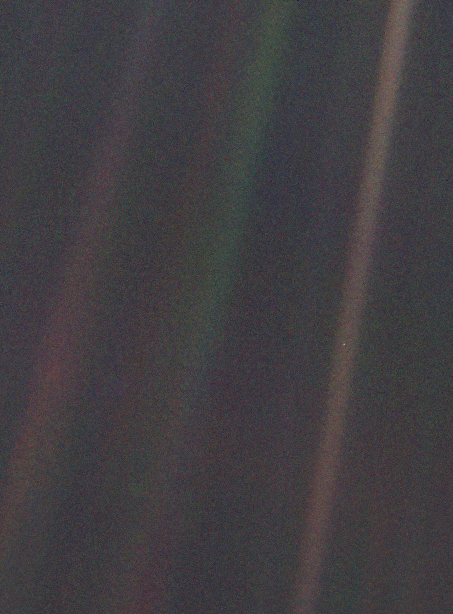
Pale Blue Dot is a photograph of Earth taken on February 14, 1990, by the Voyager 1 space probe from an unprecedented distance of approximately 6 billion kilometers (3.7 billion miles, 40.5 AU), as part of that day’s Family Portrait series of images of the Solar System.
- Voyager 1 (Wikipedia)
Voyager 1 is a space probe launched by NASA on September 5, 1977, as part of the Voyager program to study the outer Solar System and the interstellar space beyond the Sun’s heliosphere. It was launched 16 days after its twin, Voyager 2. It communicates through the NASA Deep Space Network (DSN) to receive routine commands and to transmit data to Earth. Real-time distance and velocity data are provided by NASA and JPL. At a distance of 163.1 AU (24.4 billion km; 15.2 billion mi) from Earth as of June 2024, it is the most distant human-made object from Earth. The probe made flybys of Jupiter, Saturn, and Saturn’s largest moon, Titan. NASA had a choice of either doing a Pluto or Titan flyby; exploration of the moon took priority because it was known to have a substantial atmosphere. Voyager 1 studied the weather, magnetic fields, and rings of the two gas giants and was the first probe to provide detailed images of their moons.
