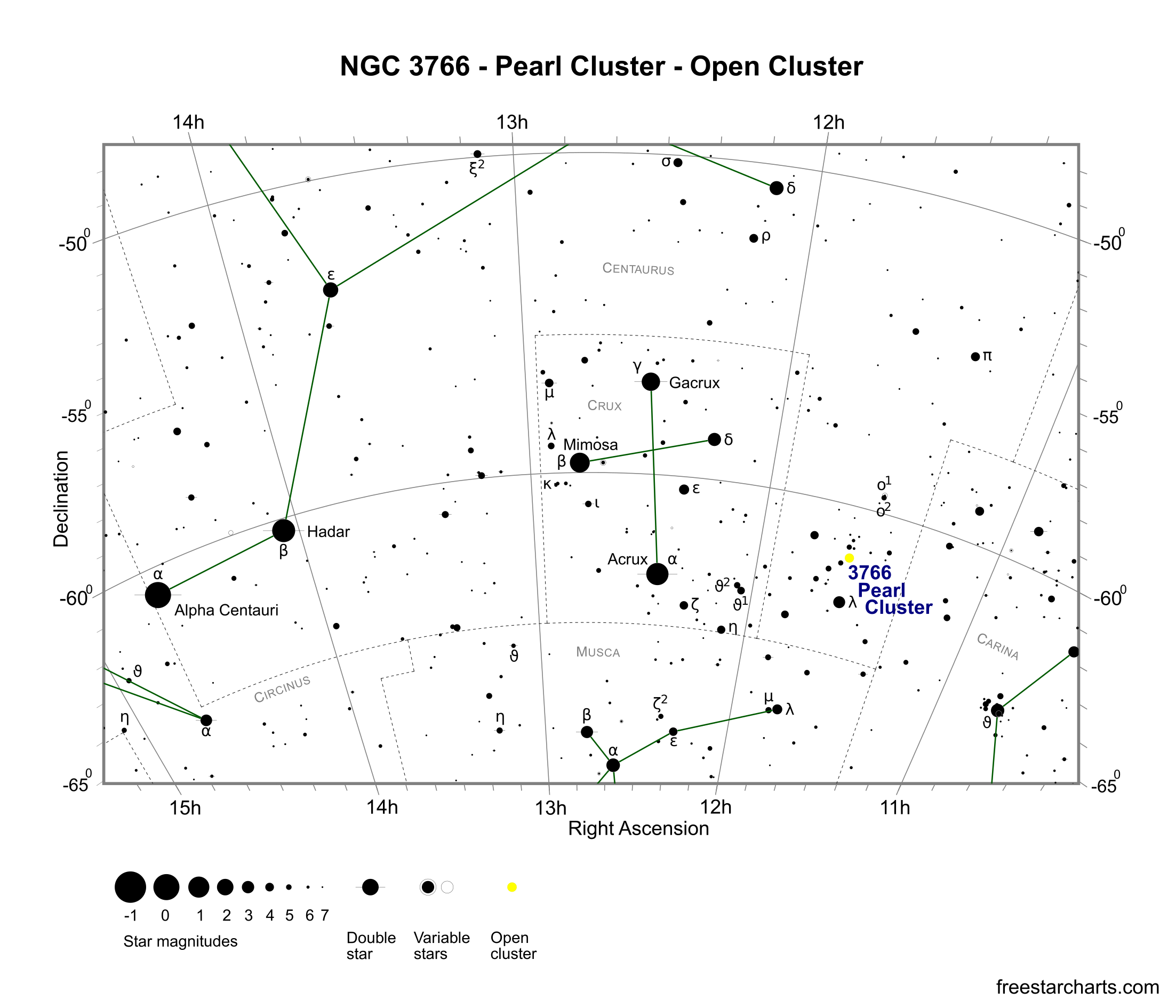
- Gacrux (stars.astro.illinois.edu)
GACRUX (Gamma Crucis). In our “western” star lore, the stars with proper names come from the set that could be seen from the lands of the ancient middle east and Arabia, and do not include those of the far southern hemisphere, which is largely invisible below the horizon from northern lands. Yet those who needed the stars to find their way, the old navigators, also needed quick names for some of the stars and just made them up. “Gacrux” is a prime example of such a star, its name deriving strictly from its Greek letter name, Gamma Crucis, the third-brightest star in the constellation Crux, the Southern Cross.
- Gacrux (Wikipedia)
Gacrux is the third-brightest star in the southern constellation of Crux, the Southern Cross. It has the Bayer designation Gamma Crucis, which is Latinised from γ Crucis and abbreviated Gamma Cru or γ Cru. With an apparent visual magnitude of +1.63, it is the 26th brightest star in the night sky. A line from the two “Pointers”, Alpha Centauri through Beta Centauri, leads to within 1° north of this star. Using parallax measurements made during the Hipparcos mission, it is 88.6 light-years (27.2 parsecs) distant. It is the nearest M-type red giant star.