Columbia River Basalt Group
eastbound on Interstate 90
Although the peoples roar like the roar of surging waters,
when he rebukes them they flee far away,
driven before the wind like chaff on the hills,
like tumbleweed before a gale.
Isaiah 17:14 NIV
- Columbia River Basalt Group Stretches from Oregon to Idaho (usgs.gov)
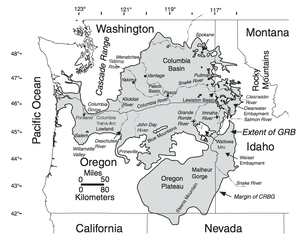
The thick, layered lava flows of the CRBG erupted as flood basalts, which originate as some of the most highly effusive eruptions in the world. The CRBG sequence a classic example of flood basalt activity that erupted more than 350 lava flows from about 16.7 Ma to 5.5 Ma. The eruptions originated from a series of generally north-northwest-trending linear fissures, ranging from tens to hundreds of kilometers in length, located along the Washington/Oregon/Idaho border. The magma that fed these massive eruptions may have come from a plume-like upwelling from the mantle called a hot spot. Since the time of the CRBG eruptions, the North American plate has moved in a west-southwestwardly motion, and that hot spot is now believed to reside beneath Yellowstone volcano in northwest Wyoming.
- Columbia River Basalt Group
- Northwest Waterfall Survey
The Pacific Northwest is home to more Waterfalls than anywhere else in North America. The Northwest Waterfall Survey was founded in order to create a thorough inventory of these outstanding natural features.
- Idaho (Wikipedia)
Idaho (/ˈaɪdəhoʊ/ EYE-də-hoh) is a state in the Pacific Northwest region of the Western United States. To the north, it shares a small portion of the Canada–United States border with the province of British Columbia. It borders the states of Montana and Wyoming to the east, Nevada and Utah to the south, and Washington and Oregon to the west. The state’s capital and largest city is Boise. With an area of 83,570 square miles (216,400 km2), Idaho is the 14th largest state by land area, but with a population of approximately 1.8 million, it ranks as the 13th least populous and the 7th least densely populated of the 50 U.S. states.