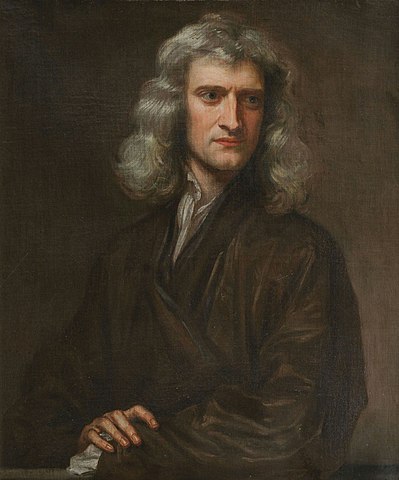
If I have seen further it is by standing on ye sholders of Giants.
random
Canon (music) (Wikipedia)In music, a canon is a contrapuntal (counterpoint-based) compositional technique that employs a melody with one or more imitations of the melody played after a given duration (e.g., quarter rest, one measure, etc.). The initial melody is called the leader (or dux), while the imitative melody, which is played in a different voice, is called the follower (or comes). The follower must imitate the leader, either as an exact replication of its rhythms and intervals or some transformation thereof. Repeating canons in which all voices are musically identical are called rounds—familiar singalong versions of “Row, Row, Row Your Boat” and “Frère Jacques” that call for each successive group of voices to begin the same song a bar or two after the previous group began are popular examples.
related
Isaac Newton (Wikipedia)Sir Isaac Newton PRS (25 December 1642 – 20 March 1726/27) was an English mathematician, physicist, astronomer, alchemist, theologian, and author (described in his time as a “natural philosopher”), widely recognised as one of the greatest mathematicians and physicists and among the most influential scientists of all time. He was a key figure in the philosophical revolution known as the Enlightenment. His book Philosophiæ Naturalis Principia Mathematica (Mathematical Principles of Natural Philosophy), first published in 1687, established classical mechanics. Newton also made seminal contributions to optics, and shares credit with German mathematician Gottfried Wilhelm Leibniz for developing infinitesimal calculus.