- Lake Michigan (Wikipedia)
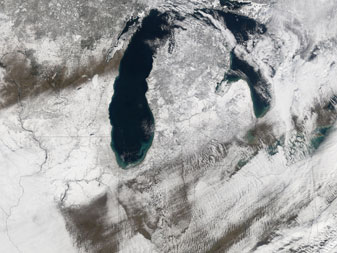
Lake Michigan (/ˈmɪʃɪɡən/) is one of the five Great Lakes of North America. It is the second-largest of the Great Lakes by volume (1,180 cu mi (4,900 km3)) and the third-largest by surface area (22,404 sq mi (58,030 km2)), after Lake Superior and Lake Huron. To the east, its basin is conjoined with that of Lake Huron through the 3+1⁄2-mile (5.6-kilometre) wide, 295-foot (90-metre; 49-fathom) deep Straits of Mackinac, giving it the same surface elevation as its easterly counterpart; the two are technically a single lake.