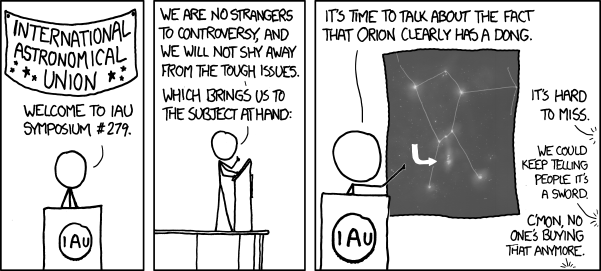
- Orion Nebula (Wikipedia)
The Orion Nebula (also known as Messier 42, M42, or NGC 1976) is a diffuse nebula situated in the Milky Way, being south of Orion’s Belt in the constellation of Orion, and is known as the middle “star” in the “sword” of Orion. It is one of the brightest nebulae and is visible to the naked eye in the night sky with an apparent magnitude of 4.0. It is 1,344 ± 20 light-years (412.1 ± 6.1 pc) away and is the closest region of massive star formation to Earth. The M42 nebula is estimated to be 24 light-years across (so its apparent size from Earth is approximately 1 degree). It has a mass of about 2,000 times that of the Sun. Older texts frequently refer to the Orion Nebula as the Great Nebula in Orion or the Great Orion Nebula.