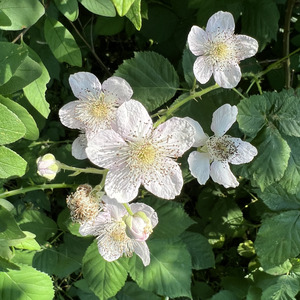
- Rubus armeniacus Focke (plants.sc.egov.usda.gov)
Himalaya blackberry fruits are highly edible and commonly collected by berry pickers. The fruit can be canned, frozen, or eaten fresh (Francis 2003). Wildlife readily consumes the fruit as well. It was used in the development of the hybrid marionberry cultivar, ‘Marion’ (Waldo 1957).
- The Babalon Working 1946: L. Ron Hubbard, John Whiteside Parsons, and the Practice of Enochian Magic (jstor.org)
In the spring of 1946 L. Ron Hubbard and John W. Parsons performed a series of magical rituals with the aim of incarnating the Thelemic goddess Babalon in a human being. Hubbard’s cooperation with Parsons, known as the Babalon Working, remains one of the most controversial events in Hubbard’s pre-Scientology days. This article sets out to describe the content of the magical rituals, as well as their purpose. It is argued that in order to fully understand these events, it is necessary to approach the Babalon Working from the study of Western esotericism in general, and the study of Enochian magic in particular.
- Rubus armeniacus (Wikipedia)
Rubus armeniacus, the Himalayan blackberry or Armenian blackberry, is a species of Rubus in the blackberry group Rubus subgenus Rubus series Discolores (P.J. Müll.) Focke. It is native to Armenia and Northern Iran, and widely naturalised elsewhere. Both its scientific name and origin have been the subject of much confusion, with much of the literature referring to it as either Rubus procerus or Rubus discolor, and often mistakenly citing its origin as western European. Flora of North America, published in 2014, considers the taxonomy unsettled, and tentatively uses the older name Rubus bifrons.