- Tukwila Formation—Andesitic to dacitic volcanic sandstone, siltstone, shale, tuff-breccia, tuff, volcanic mudflow (lahar), carbonaceous shales, and minor lava flows or sills. Typically massive; only local sedimentary interbeds indicate structure. K-Ar age on plagioclase from tuff-breccia at top of unit, about 3 km west of quadrangle, yielded an age of 42.0±2.4 Ma (Turner and others, 1983)
- arkos
- Tenino Sandstone
- Leschi Park erratic in Seattle’s Leschi Park is a sandstone erratic with many embedded bivalve fossils.
- The Chuckanut Mountains were formed by the folding of the Chuckanut Formation (which is predominantly made up of layers of 55-million-year-old sandstone, conglomerate, shale, and bituminous and sub-bituminous coal) and the later Huntingdon Formation (predominantly shale and sandstone) on top, as well as an exposed section of pre-Jurassic-age phyllite
- The Olympics are made up of obducted clastic wedge material and oceanic crust. They are primarily Eocene sandstones, turbidites, and basaltic oceanic crust.
- About 500 million years ago, a shallow sea covered the area, laying down layers of sand and minerals that make up much of the sandstone bluffs now seen along the river.
- Sandstone (Wikipedia)
Sandstone is a clastic sedimentary rock composed mainly of sand-sized (0.0625 to 2 mm) silicate grains. Sandstones comprise about 20–25% of all sedimentary rocks.
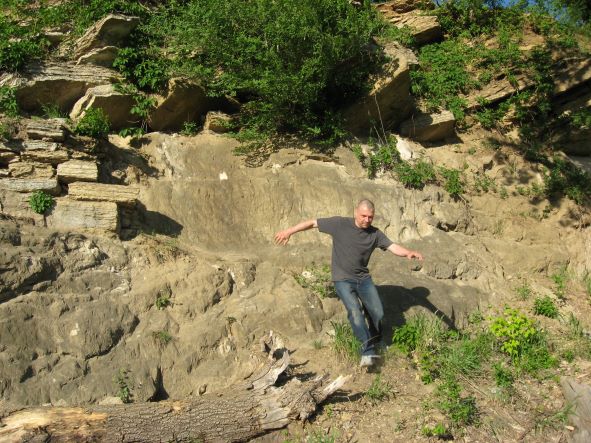 Skipping down the cliff