I was known as the chief graverobber of my state.
Dan Quayle
- Tukwila Formation—Andesitic to dacitic volcanic sandstone, siltstone, shale, tuff-breccia, tuff, volcanic mudflow (lahar), carbonaceous shales, and minor lava flows or sills. Typically massive; only local sedimentary interbeds indicate structure. K-Ar age on plagioclase from tuff-breccia at top of unit, about 3 km west of quadrangle, yielded an age of 42.0±2.4 Ma (Turner and others, 1983)
- The Chuckanut Mountains were formed by the folding of the Chuckanut Formation (which is predominantly made up of layers of 55-million-year-old sandstone, conglomerate, shale, and bituminous and sub-bituminous coal) and the later Huntingdon Formation (predominantly shale and sandstone) on top, as well as an exposed section of pre-Jurassic-age phyllite
- Shale (Wikipedia)
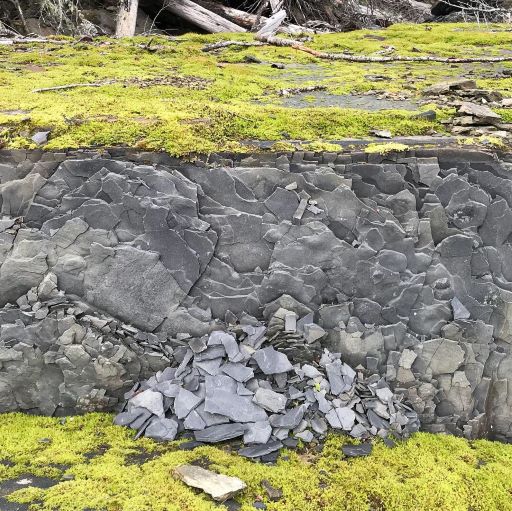
Shale is a fine-grained, clastic sedimentary rock formed from mud that is a mix of flakes of clay minerals (hydrous aluminium phyllosilicates, e.g. kaolin, Al2Si2O5(OH)4) and tiny fragments (silt-sized particles) of other minerals, especially quartz and calcite. Shale is characterized by its tendency to split into thin layers (laminae) less than one centimeter in thickness. This property is called fissility. Shale is the most common sedimentary rock.