Columbia River Basalt Group
- Steens Mountain (summitpost.org)
Stretching across the High Desert of Southeast Oregon is the most massive of the state’s peaks. From Baker Pass in the north to Long Hollow in the south, The Steens as a mountain range is nearly 60 miles long and 18 miles across. Taken as a mountain with a nine thousand foot crest, the peak runs over eight miles from north to south. This massive fault block of basalt is the highest point south of the Three Sisters in Oregon, has 4373 feet of prominence, and is the highpoint of Harney County. The nearest higher peak is Eagle Peak, a distant 125 miles away to the west in California.
- Steens Mountain (Wikipedia)
Steens Mountain is a large fault-block mountain in the northwest United States, located in Harney County, Oregon. Stretching some fifty miles (80 km) north to south, on its west side it rises from the Alvord Desert at an elevation of about 4,200 feet (1,280 m) to 9,738 feet (2,968 m) at the summit. Steens Mountain is not part of a mountain range but is properly a single mountain, the largest of Oregon’s fault-block mountains.
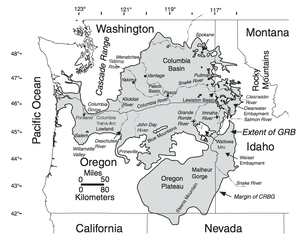 Columbia River Basalt Group map shows main regions of basalt exposure in Washington, Oregon, Idaho and Nevada, USA. (usgs.gov)