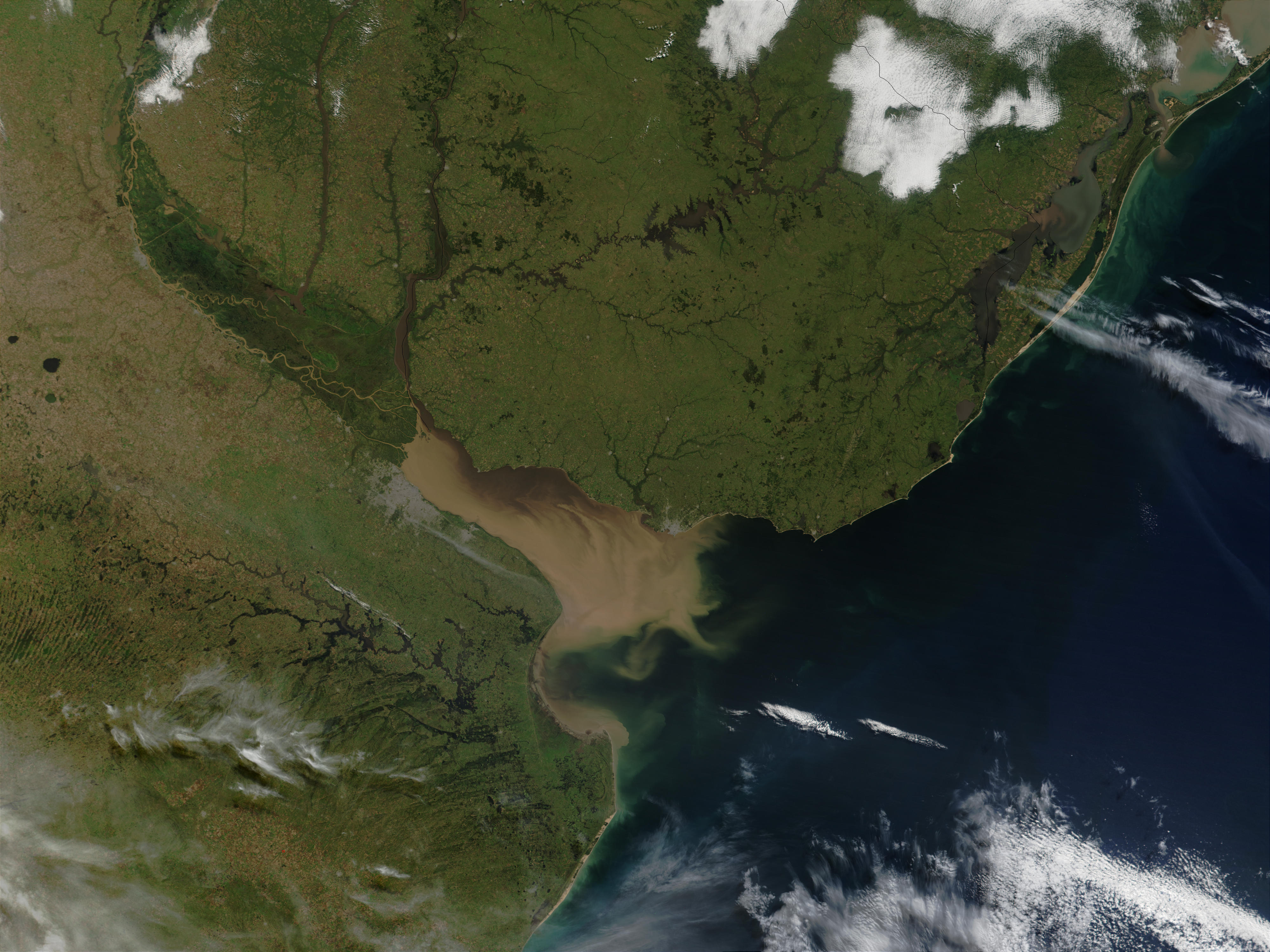
- Jacques Descloitres, MODIS Land Rapid Response Team, NASA/GSFC
- This image shows the Rio Parana in Argentina in spring and summer 2002. It was compiled from data collected by the MODIS sensor aboard the Terra satellite. MODIS was able to pick up the signature of a few fires in some of the images, shown as red dots or outlines. Rio Parana (running north-south through image center) appears brown from the sediment in the water, and eventually drains into the Delta del Parana and the Rio de la Plata Estuary. Where the Rio de la Plata empties into the Atlantic, the brown, sediment-filled river water mixes with clearer ocean water and creates swirls and cloudy formations. Visible in these image is Buenos Aires, the capital city of Argentina, located where the Rio Parana meets the Rio de la Plata. Higher resolutions of the image show just how big the city is. Another city visible in the image is Montevideo, located on the opposite side of the Rio de la Plata. Montevideo is the capital city of Uruguay. Higher resolutions of the image show how heavily cultivated this region of Argentina is — farmland is clearly recognizable by the square and rectangular patterns of vegetation on the land. Uruguay, on the other hand, is not so heavily cultivated.