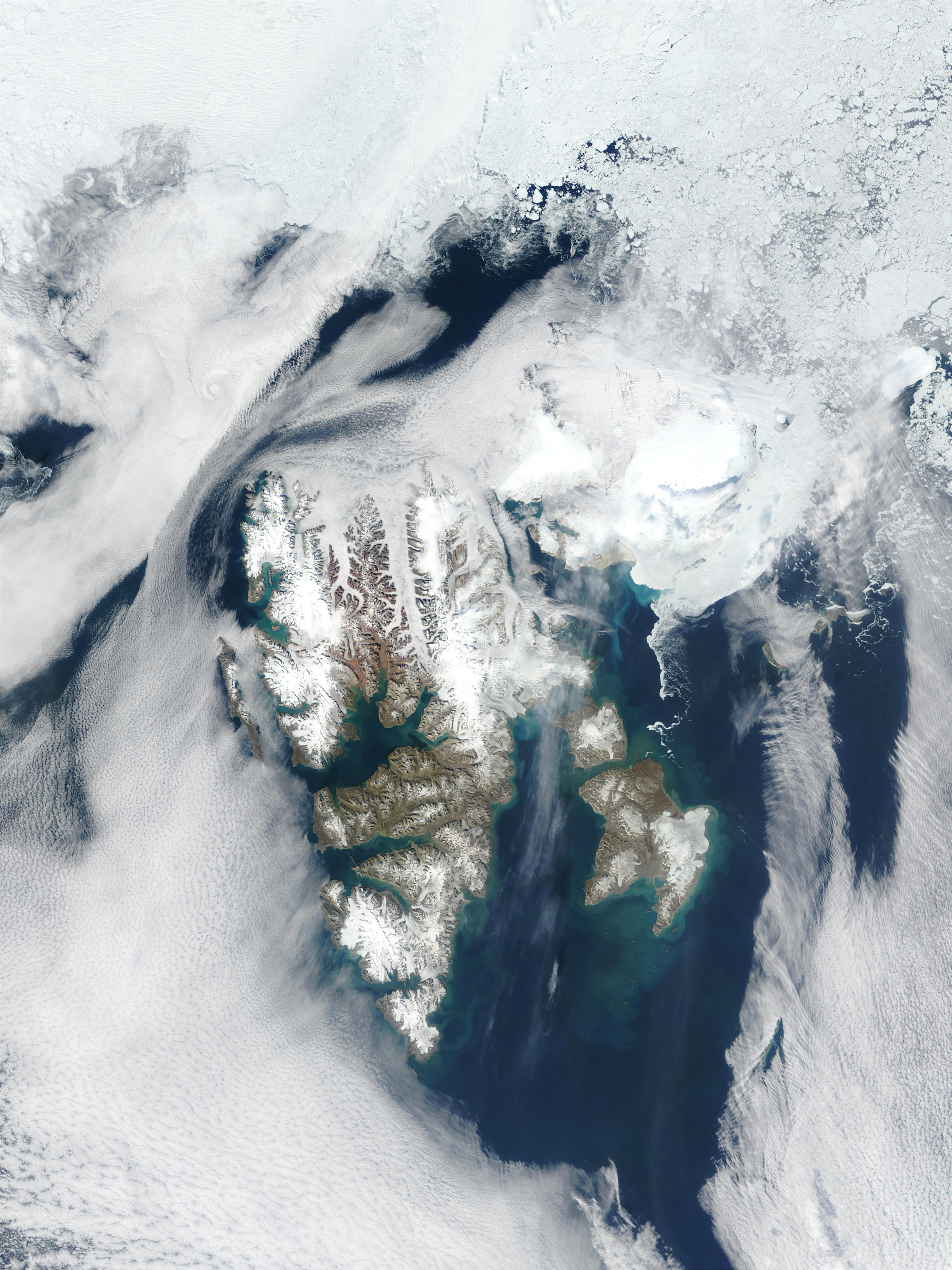
- Jacques Descloitres, MODIS Rapid Response Team, NASA/GSFC
- On May 22, 2002, Svalbard, Norway, tucked inside the Arctic Circle, was showing no signs of spring on land, while in the Barents Sea, ice had begun retreating from the western coastline. This series of images shows the thawing of the sea ice around Svalbard, and also shows snow retreating from the landscape. Patches of brown are showing through, especially along fjords and inlets. Some images show blooms of marine plants called phytoplankton, which create colorful blue and green patterns on the ocean surface.
- Black Eye Galaxy (Wikipedia)
The Black Eye Galaxy (also called Sleeping Beauty Galaxy or Evil Eye Galaxy and designated Messier 64, M64, or NGC 4826) is a relatively isolated spiral galaxy 17 million light-years away in the mildly northern constellation of Coma Berenices. It was discovered by Edward Pigott in March 1779, and independently by Johann Elert Bode in April of the same year, as well as by Charles Messier the next year. A dark band of absorbing dust partially in front of its bright nucleus gave rise to its nicknames of the “Black Eye”, “Evil Eye”, or “Sleeping Beauty” galaxy. M64 is well known among amateur astronomers due to its form in small telescopes and visibility across inhabited latitudes.